BEFORE YOU CONTINUE
The information on this website is not directed at, or intended for, persons resident or located in the United Kingdom. Nothing on it is an invitation or inducement to engage in cryptoasset activity in the UK.
By continuing, you confirm that you are not a resident of, or located in, the United Kingdom.
NOT AVAILABLE IN THE UK
FreeBnk's services are not available to residents of the United Kingdom, and this website is not directed at UK residents.

The 5 Fintech Innovations That Are Quietly Reshaping Your Future
Explore the five emerging fintech innovations that are redefining how we save, invest, and manage money in 2025 and beyond.
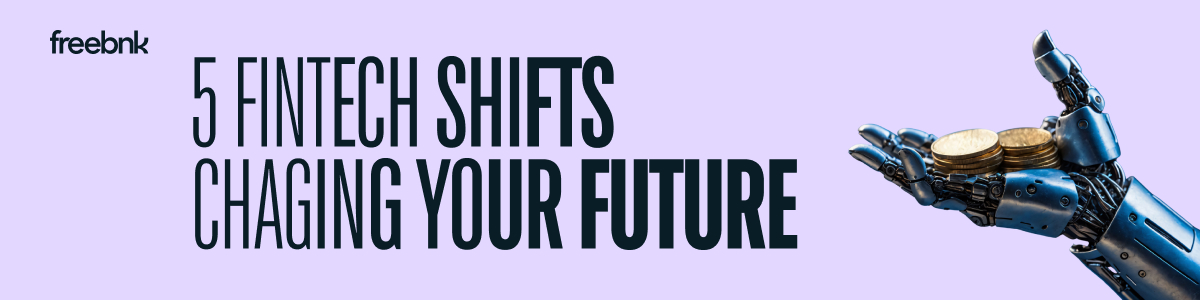
When people think about financial technology, they often picture flashy crypto ads or trading apps with confetti animations. But the most powerful fintech shifts are happening quietly, in the background — changing how we access money, build wealth, and interact with global finance.
These five innovations are reshaping the future of finance in ways that matter. Whether you’re an investor, entrepreneur, or someone trying to better manage your money, these trends are already shaping your daily financial reality.
1. Real-Time Global Transfers
Traditional wire transfers can take days and involve steep fees. But new fintech platforms (including Freebnk) are enabling instant, low-cost international transfers with just a few clicks. No middlemen. No waiting.
As real-time cross-border payments become the norm, your money will move as fast as your messages — no matter where you are.
2. Crypto-to-Stocks Integration
Holding both crypto and traditional assets used to mean juggling multiple apps, wallets, and spreadsheets. That’s changing.
Today, multi-asset platforms let you manage and convert crypto, stablecoins, and equities in one unified dashboard — and do it on your terms.
This isn’t just convenient — it’s the foundation of a future where asset classes are interoperable, not siloed.
3. AI-Powered Financial Tools
Artificial intelligence is no longer a buzzword. In 2025, AI is helping users:
- Detect unusual activity
- Automate savings
- Generate custom investment strategies
- Understand financial habits through smart insights
Freebnk is working on tools that put this kind of intelligence directly in users’ hands — making your financial life smarter without making it more complicated.
4. Embedded Finance for Businesses
Instead of building full financial infrastructure, businesses can now plug fintech into their products via APIs. This means:
- Marketplaces can offer instant payouts
- Freelancers can get virtual accounts
- Startups can launch branded cards in weeks, not years
It’s called embedded finance, and it’s redefining how companies interact with money.
5. Biometric Security
Passwords are fading. Now, facial recognition, fingerprint scans, and even voice authentication are becoming the standard for secure access to financial apps.
At Freebnk, we’re exploring biometric security as a way to deliver maximum protection with zero friction. Because security shouldn’t slow you down — it should speed you up.
Why It Matters
These innovations may not always make headlines, but they’re quietly building a better system. One that’s faster, fairer, and more flexible — especially for people who’ve been underserved by traditional banking.
Tomorrow, we’ll dive into mobile banking: is it the future of finance or just another overhyped trend?
If you’re ready to stop chasing the future and start using it — now’s the time.

225+ Crypto Cards and Counting: The Hidden Fees and Third-Party Risk Behind “Spend Your Stablecoins”
Visa counts 225+ stablecoin-linked card programmes. But a crypto card is a detour: 2–6% in fees on a purchase abroad, a third party holding or pulling your money, and merchants still paying card fees. Why stablecoin payments should start at the till.
09.11.2026
The Binance Hack Proved Stablecoins Can Be Frozen in Minutes. What It Means for Your Payouts
About $2.85B of the $6.3B Binance hack was frozen, almost all of it stablecoins. What the numbers show, why issuer freeze power is both a feature and a risk, and five checks for your stablecoin payouts.
06.11.2026

Stablecoin Payouts: Why the Last Mile Now Decides Who Wins
Visa, Coinbase, Western Union and Circle all moved into the last mile of stablecoin payments in one week. Why the payout leg, not the chain, decides your cost, and five questions for any stablecoin payout API.
27.10.2026